Redefining What’s Possible: Inside SEGA’s Modern Girl Program
By late afternoon in Mvomero, the heat lingers as the market begins to thin. Dust settles where customers once crowded, and vendors quietly tally the day’s earnings.
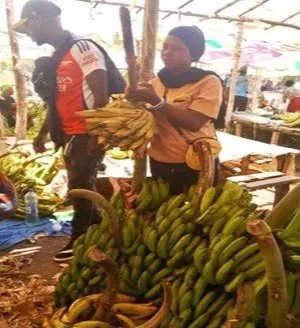
Among them is Rosemary, counting the day’s final coins; her hands still scented with bananas and cassava. But her workday is far from over. Soon, she will return home and sit behind her sewing machine, finishing a customer’s dress before nightfall.
Just a few years ago, this rhythm of independence and purpose did not exist in her life.
At 26, Rosemary is a young mother who once watched financial hardship close the door to further education, forcing her to run to small-scale farming and petty trade as a means of survival.
That began to change when she joined SEGA’s Modern Girl program known locally as Msichana wa Kisasa.
A Space to Learn, Share, and Be Seen
Across the Morogoro region, girls gather in small weekend groups led by trained mentors from their own communities. Some arrive quietly. Others speak easily. All there to learn skills that formal education alone does not always provide.
Here, conversations stretch beyond textbooks as girls talk openly about health, finances, relationships, and the decisions that shape their futures. They listen to one another, practice speaking up, and ask difficult questions. In doing so, they begin to see themselves differently.
This is the space that reshaped Rosemary’s path and today, continues to shape the lives of over 2,000 girls ages 12 to 23 across 31 communities in Tanzania.
It is the heart of SEGA’s Modern Girl program, a community-based initiative using girls’ clubs to equip girls and young women with life skills, sexual and reproductive health education, financial literacy, and entrepreneurship training.
Knowledge That Builds Confidence
For Rosemary, the most transformative sessions were those on sexual and reproductive health and rights.
There, she learned about family planning, menstrual health and hygiene, and her right to make informed decisions about her own body and future. She often reflects that she wishes she had gained this knowledge earlier in life.
Her experience reflects a broader pattern across participants. At the start of the program, only 33% of girls strongly agreed they knew their rights. By completion, that number rose to 73%.
But knowing one’s rights is only the beginning. Finding the confidence to speak up is where change becomes visible. Participants who strongly agreed they could clearly communicate their need increased from 32% to 71% during the program. The shift shows up in real moments of courage: “In my family, I demanded my right to study when my parents wanted me to drop out” shared one graduate.
This confidence extends beyond the classroom. During the program, the percentage of participants planning to practice family planning (once sexually active) increased from 48% to 79%. Proving that when girls understand both their rights and their health, they are better positioned to decide if and when to marry, have children, and plan for long-term stability.
Economic Confidence, Built Step by Step
With strengthened self-belief and knowledge came practical economic skills.
Through entrepreneurship training, Rosemary expanded her market trading and learned tailoring. She now contributes to her daughter’s needs and her family’s stability with greater consistency.
Across Modern Girl graduates, earning income increases significantly over time. At the start of the program, just 4% of participants reported earning money, then end of it, that number rises to 38%.
Like Rosemary, most graduates begin modestly – tailoring, market sales, beauty salons, etc. But these small enterprises represent something larger: financial agency and the confidence to try building something bigger over time.
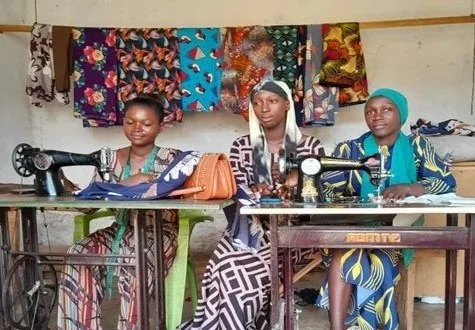
The program’s impact on Rosemary’s life echoes in other villages as well. In Mvuha, Letisia (23), Zuhura (22), and Zena (17) three Modern Girl graduates are building that independence together.
After completing SEGA’s Modern Girl program, they did something powerful: invested in one another. Pooling their savings, they opened a small tailoring workspace. They share rent and overhead while independently managing their own businesses, later expanding into fabric sales as demand grew. Through shared earnings and partnership, they reduce costs, increase stability, and grow in confidence as entrepreneurs.
Despite the many challenges they face, they remain focused, not on survival, but on building successful businesses.
Investing in What’s Possible
From Rosemary’s market stall. To Letisia, Zuhura, and Zena’s sewing machine humming after sunset. To a girl standing in her home and demanding her right to continue school. These are not isolated stories. They are evidence of what happens when girls are equipped with information, skills, and support.
SEGA’s Modern Girl Program demonstrates measurable gains in confidence, rights awareness, economic participation, and reproductive decision-making. But beyond the statistics, it cultivates something deeper: the ability for girls to see themselves as decision-makers in their own lives.
And that changes everything!
But for millions of girls around the world, that possibility is still out of reach. Early marriage, limited access to education, and deeply rooted inequities continue to shape their futures.
That is why we invite you to join us in honor of International Women’s Day for a special screening of NAWI: Dear Future Me, a powerful coming-of-age story about courage, resistance, and a girl determined to choose her own path.
This gathering is more than a film screening. It is an opportunity to stand in solidarity with girls who are fighting for their education and their futures, and to reflect on the work still ahead.
Following the screening, we’ll host a live Q&A with the film’s key contributors, offering a rare opportunity to go deeper into the story behind NAWI, the realities that inspired it, and the global movement working to end child marriage.
Reserve your seat and be part of the conversation: